Mesogobius batrachocephalus Índice Morfologia | Alimentação | Habitat | Distribuição geográfica | Observações | Referências Bibliografia | Ligações externas | Menu de navegaçãoBioLibFishBaseAQUATABWorld Register of Marine SpeciesITISexpandindo-oe
GobiidaeMesogobiusEspécies descritas em 1814
espéciepeixefamíliaGobiidaeordemPerciformespeixepeixeclima temperadoMar NegroMar de Azovhumanos
Mesogobius batrachocephalus | |||||||||||||||||||||
|---|---|---|---|---|---|---|---|---|---|---|---|---|---|---|---|---|---|---|---|---|---|
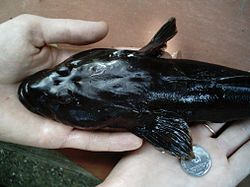 | |||||||||||||||||||||
Classificação científica | |||||||||||||||||||||
| |||||||||||||||||||||
Nome binomial | |||||||||||||||||||||
Mesogobius batrachocephalus (Pallas, 1814)[2][3] | |||||||||||||||||||||

Mesogobius batrachocephalus é uma espécie de peixe da família Gobiidae e da ordem Perciformes.
Índice
1 Morfologia
2 Alimentação
3 Habitat
4 Distribuição geográfica
5 Observações
6 Referências
7 Bibliografia
8 Ligações externas
Morfologia |
- Os machos podem atingir 34,5 cm de comprimento total[4] e 600 g de pes[5].[6]
Alimentação |
Alimenta-se principalmente de peixe.[7]
Habitat |
É um peixe de clima temperado (4°C-18°C)[8] e demersal que vive entre 20-100 m de profundidade.[6]
Distribuição geográfica |
É encontrado no Mar Negro e Mar de Azov.[6][9][10][11][12][13][14][15][16][17]
Observações |
É inofensivo para os humanos.[6]
Referências
↑ Bleeker, P., 1874. Esquisse de un système naturel des Gobioïdes. Arch. Neerl. Sci. Nat., Haarlem v. 9. 289-331.
↑ BioLib (em inglês)
↑ Peter Simon Pallas, 1814. Zoographia Rosso-Asiatica, sistens omnium animalium in extenso Imperio Rossico et adjacentibus maribus observatorum recensionem, domicilia, mores et descriptiones anatomen atque icones plurimorum. 3 vols. [1811-1814]. Petropoli. Zoographia Rosso-Asiatica, sistens omnium animalium... v. 3: i-vii + 1-428 + index (I-CXXV), Pls. 1, 13, 14, 15, 20 and 21.
↑ Miller, P.J. 1986. Gobiidae. p. 1019-1085. A P.J.P. Whitehead, M.-L. Bauchot, J.-C. Hureau, J. Nielsen e E. Tortonese (eds.) Fishes of the North-eastern Atlantic and the Mediterranean. Vol. 3. UNESCO, París.
↑ Reshetnikov, Y.S., 2003. Atlas of Russian freshwater fishes, Vol. 2. Moscow Nauka.
↑ abcd FishBase (em inglês)
↑ Miller, P.J. 1986. Gobiidae. p. 1019-1085.
↑ Baensch, H.A. e R. Riehl, 1991. Aquarien atlas. Bd. 3. Melle: Mergus, Verlag für Natur- und Heimtierkunde, Alemanha. 1104 p.
↑ Bilecenoglu, M., E. Taskavak S. Mater e M. Kaya, 2002. Checklist of the marine fishes of Turkey. Zootaxa (113):1-194.
↑ Economidis, P.S., 1973. Catalogue of the fishes of Greece. Reprinted from Hellenic Oceanology and Limnology, Praktika of the Inst. of Ocean. and Fishing Research, vol. 11 (1972).
↑ Kottelat, M., 1997. European freshwater fishes. Biologia 52, Suppl. 5:1-271.
↑ Kottelat, M. e J. Freyhof, 2007. Handbook of European freshwater fishes. Publications Kottelat, Cornol, Suíça. 646 p.
↑ Louisy, P., 2001. Guide de identification des poissons marins. Europe et Méditerranée. París: Eds. Eugène Ulmer.
↑ Miller, P.J., 1979. Gobiidae. p. 483-515. A: J.C. Hureau e Th. Monod (eds.) Check-list of the fishes of the north-eastern Atlantic and of the Mediterranean (CLOFNAM). UNESCO, París. Vol. 1.
↑ Reshetnikov, Y.S., N.G. Bogutskaya, E.D. Vasil'eva, E.A. Dorofeeva, A.M. Naseka, O.A. Popova, K.A. Savvaitova, V.G. Sideleva e L.I. Sokolov, 1997. An annotated check-list of the freshwater fishes of Russia. J. Ichthyol. 37(9): 687-736.
↑ Salekhova, L.P., N.S. Kostenko, T.A. Bogachick e O.N. Minibaeva, 1988. Composition of ichthyofauna in the region of the Karadag State Reserve (Black Sea). J. Ichthyol. 28(2):16-23.
↑ Svetovidov, A.N., 1964. Handbook of the fauna of the USSR, fishes of the Black Sea. Izdatel'stvo Nauka, Moscou, 550 p.
Bibliografia |
- Anónimo 2001. Base de dados da colecção de peixes do National Museum of Natural History (Smithsonian Institution). Smithsonian Institution - Division of Fishes.
- Anónimo 2002. Base de dados da colecção de peixes do American Museum of Natural History. American Museum of Natural History, Central Park West, NY 10024-5192, Estados Unidos da América.
- Bilko, V.P., 1971. Comparative characteristics of the growth of gobiids (fam. Gobiidae) and Lea phenomena Vopr. Ikhtiol. 11(4): 650-663.
- Ivanov, V.N., 1975. Chromosomes of the Black sea Gobiidae - Gobius melanostomus (Pallas) and Gobius batrachocephalus (Pallas). Tsitologiya e Genetika (Cytology and Genetics). 9(6):551-552. Kiev.
- Vasil'ev, V.P., 1980. Chromosome numbers in fish-like vertebrates and fish. J. Ichthyol. 20(3): 1-38.
- Wu, H.L., K.-T. Shao e C.F. Lai (eds.), 1999. Latin-Chinese dictionary of fishes names. The Sueichan Press, Taiwan.
Ligações externas |
- AQUATAB
World Register of Marine Species (em inglês)
ITIS (em inglês)


